We went for inspiration, but came back with much more: new ideas, great contacts, and renewed energy to keep building. Literally and figuratively.
The Trip to Montpellier: A strategic look at experience, positioning, and design
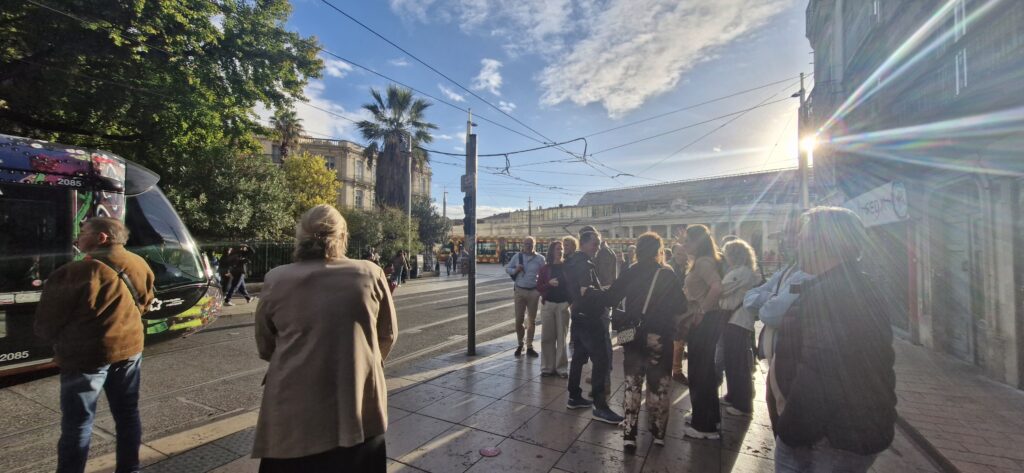
A creative mind never stands still. But true new insight sometimes only emerges when you consciously take a step back. That’s exactly what I did last November, joining a group of about thirty entrepreneurs on an inspiration trip to Montpellier. An initiative by HISWA-RECRON and Richard Otten, the goal was to explore: How do French holiday parks create their own identity? What makes them stand out? And how does the experience translate into higher ratings and occupancy? So, it wasn’t a holiday, even though it sometimes felt like one. It was primarily research: seeing how choices, behavior, and visual language come together in the total guest experience.
The group consisted of holiday park owners, marketing managers, concept developers, suppliers, and representatives from HISWA-RECRON, France Compagnie, and Leisuretalk. We visited the SETT trade fair as well as several holiday parks during the low season. This allowed us to literally see behind the scenes how they are working on innovations for 2026. It’s worth noting that in some parts of France, the government determines when parks open and close due to flood risks. This makes the low season a true low season, providing plenty of room for construction, renovation, and redesign.
Club Farret – Theming as a strategy
At Club Farret in Vias-Plage, it became clear immediately: theming isn’t just a nice extra here, but a deliberate strategy. Every district has its own visual identity. Use of color, lighting, and materials are fully aligned with the area’s theme.
In my eyes, some elements were a bit rough in terms of placement or finish. But because the styling is carried out so consistently, the guest really gets swept up in it. If you look at it from a professional bird’s-eye view like I do, you see exactly how the park is divided into zones. Each has its own story and expectation. It works. Even with accommodations that aren’t luxury, the park is already fully booked early in the season.
Delphine Delfin showed us the Marina and Pacific districts, among others. There, guests can literally sit with their feet in the water from their terrace. The accommodations have a simple finish, and that turns out to be their strength. Tastes differ from country to country, but the clear direction ensures success.
Blendin Agde – Space & tranquility as a premium product
Blendin Agde takes a completely different approach. Here, peace and quiet isn’t a byproduct, but a conscious design choice. Natural materials, soft colors, and well-planned sightlines create a sense of luxurious simplicity. The park feels spacious because they don’t build to maximum capacity, but instead create breathing room between the lodges. Being less cramped means higher quality and better reviews. Sometimes, leaving things out is the most profitable decision.
Something else that immediately stood out: the fully integrated wheelchair-friendly accommodations next to the parking lot. They were fully integrated into the initial design rather than added as an afterthought. These kinds of choices are a hallmark of quality: functional, thoughtful, and logically positioned. It made me quite happy to see.
La Dragonnière – How one intervention makes the difference
At Sandaya’s Domaine de La Dragonnière, we saw something that hardly exists in the Netherlands yet: an artificial lagoon as an experience element. Clear blue, chlorine-free water that creates an instant resort feeling and a real summer vibe, even on a chilly November day. Perhaps this could be a great addition to parks in the Netherlands where laws and regulations don’t allow for a standard swimming pool? In any case, the lagoon shows how one strong spatial intervention can reposition an entire park. It’s distinctive, Instagrammable, and functional at the same time.
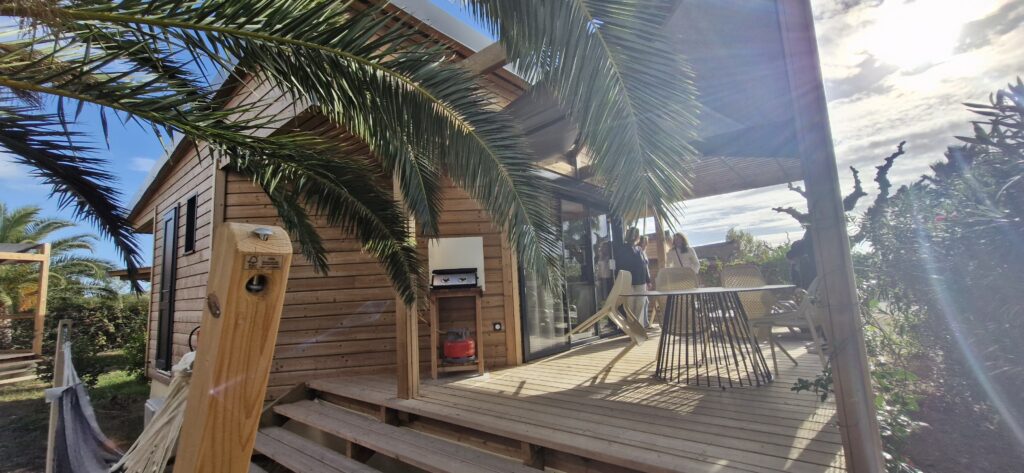
The area renovations were also striking. New accommodations featuring a new roof type, raised decking, and a pergola. A relatively small upgrade that has a surprisingly large effect. We only discovered later that we were essentially looking at the same model as the older units (minus the new elements).
A clear lesson: strong aesthetic choices and smart construction options can completely refresh a park without full replacement.
Sérignan-Plage – Guest-centricity as brand identity
Yelloh Village Sérignan-Plage opts for a form of hospitality that stands out. Sitting in a homely reception area, guests are checked in with time and attention. Even on the busiest days. And that’s at a large park. This feels credible and personal to the guest—a lovely start to a stay at a spacious park with an extensive range of facilities.
The park is also cleverly laid out: a textile section and a nudist section, both with access to shared facilities like the wellness area. A logical separation of experiences and a smart use of capacity.
SETT Montpellier – A strategic must-see for recreation entrepreneurs
Every forward-thinking recreation entrepreneur should really visit the SETT trade fair at some point. If you want to look ahead, one visit gives you a major advantage. You can find trends and novelties here before they even become visible in the Netherlands.
Walking around for one day feels like absorbing a year’s worth of development all at once. It shows with razor-sharp clarity what is possible technically, aesthetically, and commercially. And that is exactly what allows you as an entrepreneur to better determine which choices fit your guests and your strategy.
Yelloh!
On the final day, we started at Yelloh!, where Ward Wijngaert walked us through the growth behind the brand. He told us about the nearby Les Petits Camargues, among other things. Four parks that once existed independently have now been merged into one large entity. The beauty of it is that each district was allowed to keep its own identity. You see a historic neighborhood, a cottage district, a playful zone for families, and a neighborhood entirely centered around water and water sports. We didn’t visit it, but the image Ward painted was inspiring enough. By letting each part tell its own story, you connect with guests on multiple levels. And behind the scenes, you benefit from collective strength, from purchasing to marketing.
Sandaya
Finally, we were welcomed at the headquarters of Groupe Sandaya, where Anna Pasco Chamot took us behind the scenes. Building on our visit to La Dragonnière, we were introduced to their vision for the future. They mentioned the possibility of gaining a foothold in the Netherlands as well. After this interesting visit, we did one last quick round of the fair. Gathering inspiration, looking for familiar faces, and wrapping up conversations. Then it was over: back to the Netherlands.
The recreation sector remains a wonderful industry, and this trip proved that once again. From the very first moment, there was a sense of ease within the group. No feeling of competition, just sharing and thinking along. What do you see, what do I see, and what do we think of it? That’s what makes a trip like this so valuable: it sets something in motion.
We went for inspiration, but came back with much more: new ideas, great contacts, and renewed energy to keep building. Literally and figuratively.